
NEET Physics Preparation Strategy 2027: Chapter Priorities, Study Plan and Smart Tips
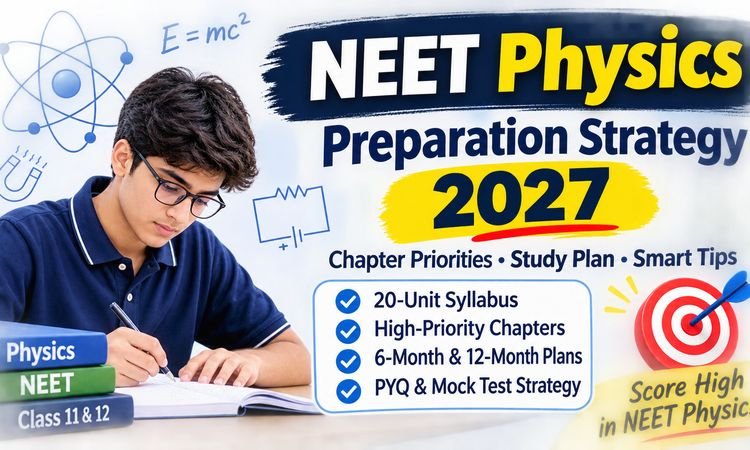
Physics is where many NEET ranks are made, and also where many students lose the most marks. Biology mostly rewards what you remember. Physics also asks you to think, and to do it quickly.
The good news is that NEET Physics is more predictable than it feels. The syllabus is fixed, the paper has 45 questions, and the question style stays fairly consistent from year to year. With the right order of study, regular practice and honest mistake analysis, most students can improve their Physics score step by step.
This guide gives you a clear plan: what the paper looks like, which chapters deserve extra time, how to study month by month, and how to practise so that your effort turns into marks.
| Quick answer: how to prepare Physics for NEET 2027 Learn the 20-unit syllabus from NCERT first. Give extra time to high-frequency chapters such as Current Electricity, Rotational Motion, Optics, Electrostatics and Semiconductor Electronics. Practise topic-wise MCQs and previous year questions, keep a mistake notebook, revise formulas every week and take timed mock tests regularly. |
Key takeaways
- NEET Physics has 45 compulsory questions worth 180 marks, which is one-fourth of the paper.
- The syllabus has 20 units from Class 11 and Class 12. Communication Systems is not part of the current syllabus.
- Concepts first, speed second. Fast solving only works when the basics are clear.
- A mistake notebook and weekly mock tests do more for your score than collecting extra books.
- Always confirm the final pattern and exam mode in the official NTA information bulletin.
NEET 2027 Physics at a glance
Here is the paper format students are currently preparing for, based on the latest NEET pattern.
| Detail | What to expect |
| Physics questions | 45 questions, all compulsory |
| Physics marks | 180 marks (one section, no optional questions) |
| Marking scheme | +4 for a correct answer, −1 for a wrong answer |
| Whole paper | 180 questions, 720 marks, 3 hours (Physics, Chemistry, Botany, Zoology) |
| Syllabus | Class 11 and Class 12, 20 units as per the NMC syllabus for NEET UG 2026 (the latest official reference) |
The official notification for NEET 2027 is expected in early 2027. NTA will confirm the final pattern and whether the exam is pen-and-paper or computer-based. Check neet.nta.nic.in for the latest update and treat anything announced there as final.
What NEET Physics questions actually test
NEET Physics is mostly about clear concepts and clean application. You will usually see a mix of conceptual questions, short numericals, and graph or diagram-based questions. Very long, multi-step problems are uncommon.
That is why random question solving without understanding rarely works. If you know why a formula holds and when it applies, even a twisted question becomes manageable.
Know the syllabus: 20 units in NEET Physics
Before planning anything, know exactly what you are preparing. The official syllabus is organised into 20 units.
| Class 11 units | Class 12 units |
| 1. Physics and Measurement | 11. Electrostatics |
| 2. Kinematics | 12. Current Electricity |
| 3. Laws of Motion | 13. Magnetic Effects of Current and Magnetism |
| 4. Work, Energy and Power | 14. Electromagnetic Induction and Alternating Currents |
| 5. Rotational Motion | 15. Electromagnetic Waves |
| 6. Gravitation | 16. Optics |
| 7. Properties of Solids and Liquids | 17. Dual Nature of Matter and Radiation |
| 8. Thermodynamics | 18. Atoms and Nuclei |
| 9. Kinetic Theory of Gases | 19. Electronic Devices |
| 10. Oscillations and Waves | 20. Experimental Skills |
Download the official syllabus from the National Medical Commission or the NTA website and keep a printed copy with you. Tick each topic as you finish it.
Which Physics chapters should you prioritise?
Every unit matters, but not every unit gives the same return on your time. Past NEET papers show that some chapters appear more often than others. The table below groups chapters by how frequently they have appeared. It is a trend-based guide, not an official weightage, and the exact number of questions changes every year.
| Priority | Chapters | How to treat them |
| High | Current Electricity, Rotational Motion, Optics (especially ray optics), Electronic Devices (semiconductors), Physics and Measurement, Electrostatics (potential and capacitance), Magnetic Effects of Current | Study first. Revise often. These chapters have regularly brought several questions each, with Current Electricity often contributing around 4 to 5. |
| Medium | Dual Nature, Atoms and Nuclei, Electromagnetic Induction and AC, Electromagnetic Waves, Gravitation, Work-Energy-Power, Properties of Solids and Liquids, Oscillations and Waves, Kinematics | Usually 1 to 3 questions each. Learn the core formulas and typical question types well. |
| Foundation | Laws of Motion, Thermodynamics, Kinetic Theory of Gases, Magnetism and Matter, Thermal Properties, Experimental Skills | Fewer questions in recent trends, but many of these concepts support other chapters. Do not skip them. |
A useful rule: complete the whole syllabus first, and use this table only to decide where to spend extra revision time. Skipping a chapter completely is a risk, because NEET can surprise you.
A realistic study plan for NEET 2027
The right plan depends on how much time you have. NEET is usually held in the first half of May, so students starting in the last months of the year have roughly five to six months. Choose the plan that matches your situation.
If you have about 6 months
| Phase | Duration | What to do |
| Core concepts | Months 1 to 2 | Finish the high-priority chapters from NCERT. Make a one-page formula and concept sheet for each chapter. |
| Complete and practise | Months 3 to 4 | Cover the remaining chapters. Solve topic-wise MCQs after each one. Start PYQs chapter by chapter. |
| Test and refine | Month 5 | Take weekly full mock tests. Analyse each mock and fix repeated mistakes. |
| Final revision | Last 4 weeks | Revise formula sheets and the mistake notebook. Take timed mocks. Avoid starting new books. |
If you have 10 to 12 months
| Phase | Duration | What to do |
| Build the base | Months 1 to 4 | Study every unit from NCERT. Solve examples and exercises. Clear doubts the same week. |
| Strengthen | Months 5 to 8 | Topic-wise MCQs, PYQs and one chapter test every week. Start the mistake notebook. |
| Test and revise | Months 9 to 12 | Weekly full mocks, regular revision cycles and targeted work on weak chapters. |
A simple weekly routine
| Day | Focus |
| Monday to Thursday | New topic or chapter, NCERT reading and basic questions |
| Friday | MCQ practice on the week’s topics |
| Saturday | Revision of formula sheets and doubt solving |
| Sunday | Chapter test or full mock, followed by error analysis |
Touch Physics every day, even if it is only 60 to 90 minutes on a busy day. A gap of a week makes formulas and ideas fade quickly.
| Stuck on a Physics chapter? Get your doubts cleared in live online Physics classes. Learn one-to-one or in a small group of 4 to 5 students, with regular tests and personal feedback. Not sure what suits you? Read how to choose the right Physics teacher for NEET. |
How to study each chapter: a 5-step loop
Use the same loop for every chapter. It keeps your preparation simple and measurable.
- Learn: read the NCERT chapter line by line, including diagrams, graphs and solved examples.
- Note: write a one-page sheet with formulas, conditions, units and common traps.
- Solve: attempt NCERT questions first, then topic-wise MCQs, without looking at solutions.
- Review: mark every wrong or guessed question and find the reason.
- Revise: come back after a few days and again after a few weeks, solving the same weak questions.
Choose your books carefully
Too many books is a common trap. Keep a simple set and finish it properly.
| Resource | Purpose |
| NCERT Class 11 and 12 Physics | Your base. Read everything, including examples and diagrams. |
| One concept book | For deeper understanding when NCERT feels thin. HC Verma is a popular choice. |
| One practice book | Topic-wise NEET-level MCQs for application. DC Pandey or a good MCQ book works. |
| Previous year NEET papers | The best guide to real question style and difficulty. |
Solving one book twice is better than starting three books and finishing none.
How to use previous year questions properly
PYQs show you what NEET really asks, but only if you use them in the right order.
- Solve PYQs after you finish a chapter, not before.
- Attempt them without checking the solution first.
- Note which chapters repeat and which question types keep coming back.
- Re-attempt the questions you got wrong after 10 to 15 days.
Solving 200 questions and learning from every error beats solving 500 questions casually.
Keep a mistake notebook
This single habit separates average preparation from strong preparation. For every wrong answer, record a few lines in a table like this.
| Chapter | Mistake type | What went wrong | Correct approach |
| Current Electricity | Concept | Mixed up series and parallel logic | Redraw the circuit, then simplify step by step |
| Optics | Sign | Wrong sign in the mirror formula | Fix the sign convention before substituting values |
| Rotational Motion | Calculation | Squared the radius incorrectly | Write each step, check units at the end |
Review the notebook every weekend. After a few weeks you will see your own pattern, whether it is concepts, formulas, calculation or reading the question. Fixing that pattern is the fastest way to gain marks.
Build speed and accuracy for exam day
Knowing Physics is not enough. You must also solve it within the time limit, with negative marking in mind.
- As a starting point, aim to finish Physics in about 50 to 55 minutes in mock tests, then adjust to your own strengths.
- Attempt the questions you are sure of first, and return to the harder ones later.
- Do not spend more than 1.5 to 2 minutes on a single question.
- Guess only when you can eliminate at least one or two options with logic.
- Practise quick calculation: squares, simple fractions, powers of ten and unit conversions.
Take as many full-length mocks as your time allows, and spend as much time analysing each mock as you spent attempting it.
Your last 30 days checklist
- Revise formula sheets and the mistake notebook every few days.
- Re-read NCERT diagrams, graphs and summary points.
- Take timed mocks at the same time of day as the real exam.
- Revise high-priority chapters twice, and weaker chapters at least once.
- Do not start a new book or a new teacher in the final weeks.
- Sleep well. A tired mind makes silly calculation errors.
Common NEET Physics mistakes to avoid
- Memorising formulas without understanding them. One twist in the question and the formula fails.
- Skipping NCERT diagrams and examples. Many questions are built on exactly those lines.
- Ignoring units and dimensions. They catch many careless errors.
- Only watching lectures. Understanding comes from solving, not just watching.
- Not revising. Physics fades quickly without repeated revision.
- Switching resources again and again. Consistency beats variety.
- Taking mocks but not analysing them. The learning is in the review.
Expert tips from Jai Rai Sir
Jai Rai Sir, founder of Physics Point, has more than 20 years of experience teaching Physics to JEE and NEET aspirants. These are the habits he encourages in students preparing for NEET Physics:
- Understand the why before the formula. If you know where a formula comes from, you can handle questions that look unfamiliar.
- Practise a little every day. A few good questions daily work better than a large batch once a week.
- Fix weak chapters early. Physics chapters build on each other, so a gap in one topic quietly affects the next.
- Revise in short, repeated rounds. Quick weekly revisions of formulas and concepts stay in memory far longer than one long revision at the end.
- Read graphs, diagrams and units carefully. Many marks are lost not because the concept is unknown, but because a graph, a sign or a unit was misread.
- Treat every wrong answer as a lesson. Mistakes are information. Note them, understand them and do not repeat them.
| Make NEET Physics easier with expert guidance Join live online Physics classes for clear concepts, doubt support and regular test practice, and see the teaching style for yourself in a free demo. |
Frequently asked questions
How many Physics questions come in NEET?
Physics has 45 compulsory questions carrying 180 marks in the current NEET format. Check the official NTA information bulletin for the final NEET 2027 pattern.
Is NEET Physics difficult?
Many students find it the toughest section because it needs both concepts and calculation. With clear basics and regular practice, it becomes much more manageable.
Which Physics chapters are most important for NEET?
Based on past trends, Current Electricity, Rotational Motion, Optics, Electrostatics, Semiconductor Electronics, Units and Measurements and Magnetic Effects of Current appear frequently. Treat this as a guide, not a guarantee.
Is NCERT enough for NEET Physics?
NCERT is the foundation and you should know it completely. Most students also need one practice book and previous year questions for enough application practice.
How many months do I need to prepare NEET Physics?
Ten to twelve months is comfortable. With around six months, it is still possible if you focus on high-priority chapters first and revise consistently.
How many marks should I aim for in NEET Physics?
It depends on your target college. A good approach is to check the previous year’s cutoffs and track your mock test scores against your own target.
Is Communication Systems in the NEET Physics syllabus?
No. The latest official NEET syllabus has 20 Physics units and does not include Communication Systems. Always verify against the official NMC or NTA syllabus.
Can I prepare NEET Physics online?
Yes. Online preparation works well when you have live classes, doubt support, weekly tests and the discipline to practise daily. You can also explore online Physics tutoring for Class 11 and 12 students.
How can I improve my Physics score quickly?
Revise your formula sheets, redo the questions in your mistake notebook and take timed mock tests. Fixing repeated mistakes usually gives the fastest improvement.
Final words
NEET Physics rewards students who are consistent, not just hardworking. Build your concepts, practise in layers, revise often and learn from every mistake.
Start with one chapter today. Make a formula sheet, solve a few questions and note your errors. Small, regular steps add up to a strong score. If you also want to see how different teaching styles compare, read our guide to comparing Physics teachers across India.